
Unless you’ve spent the last two years completely offline, you know all about the GLP-1 revolution. Medications like Ozempic, Wegovy, and Mounjaro have dominated headlines for their ability to manage type 2 diabetes and drive significant weight loss.
Now, scientists are uncovering another potential benefit that has oncologists taking notes: these medications appear to noticeably lower the risk of several obesity-related cancers.
Let’s break down what the latest research actually shows, why it happens, and what it means for everyday health.
What Does the Data Show?
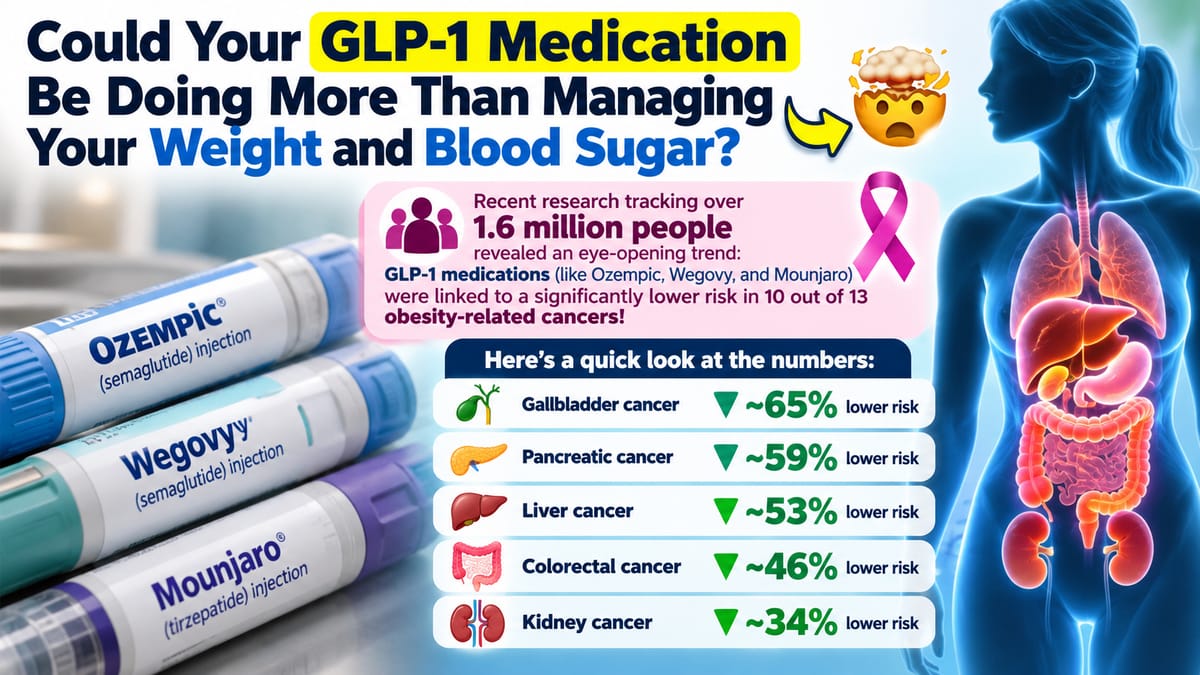
Earlier this year, a landmark study published in JAMA Network Open analyzed health records from over 1.6 million people with type 2 diabetes over a 15-year period. Researchers tracked 13 distinct cancers known to be linked to excess weight.
When researchers compared patients taking GLP-1 medications against those using insulin, the results were striking: GLP-1 users had a significantly lower risk in 10 out of the 13 cancers.
Here is a look at where the biggest drops occurred:
- Gallbladder cancer: ~65% lower risk
- Pancreatic cancer: ~59% lower risk
- Liver cancer: ~53% lower risk
- Ovarian cancer: ~48% lower risk
- Colorectal cancer: ~46% lower risk
- Esophageal cancer: ~40% lower risk
- Kidney cancer: ~34% lower risk
- Endometrial (uterine) cancer: ~26% lower risk
(Note: When compared to metformin—an older, widely used diabetes drug that already has well-documented cancer-protective properties—GLP-1s showed comparable results.)
Why Would a Weight-Loss Drug Reduce Cancer?
At first glance, it sounds too good to be true. How does a metabolic injection change your cellular risk profile?
Scientists attribute this to two primary mechanisms: systemic changes throughout the body and direct cellular signals.
1. Turning Down the “Fertilizer” in Your Bloodstream
Cancer cells thrive under specific conditions: high fuel, constant inflammation, and abundant growth signals. GLP-1s systematically disrupt that environment:
- Lowering Insulin and Growth Signals: When your body is insulin-resistant, it pumps out extra insulin and a hormone called IGF-1. Think of excess insulin as plant food for abnormal cells—it encourages them to multiply quickly. By restoring insulin sensitivity, GLP-1s cut off that extra growth fuel.
- Calming Chronic Inflammation: Excess adipose (fat) tissue keeps the immune system in a low-grade state of chronic distress, releasing inflammatory markers that damage DNA over time. Losing fat tissue helps calm this systemic simmer.
- Normalizing Hormones: Fat tissue acts like an endocrine gland, producing estrogen and pro-inflammatory signaling proteins. Excess estrogen is a major fuel source for reproductive cancers (like uterine, ovarian, and certain breast cancers). Reducing fat mass lowers circulating estrogen levels.
2. Direct “Brakes” on Abnormal Cells
It’s not just about losing pounds. GLP-1 receptors also live directly on the surface of various tissues, immune cells, and even certain cancer cells:
- The "Stop Multiplying" Signal: When a GLP-1 drug binds to these cellular receptors, it can trigger internal pathways (like cAMP/PKA) that tell cells to stop dividing aggressively or undergo apoptosis (programmed cell death).
- Waking Up the Immune System: Chronic obesity can exhaust your body’s "natural killer" (NK) cells—the microscopic security guards that identify and eliminate mutated cells before they turn into tumors. Early evidence suggests GLP-1s help restore the natural hunting ability of these immune cells.
The Catch: What You Need to Know
While the headlines are encouraging, nuance matters:
- These are observational studies: Researchers looked back at massive sets of patient charts. While the association is strong, we still need randomized clinical trials specifically designed to track cancer over decades to confirm direct cause-and-effect.
- They are not cancer drugs: Regulators approve GLP-1 medications for diabetes, chronic weight management, and reducing cardiovascular risks—not as primary cancer treatments.
- The benefits mirror healthy weight loss: Much of the anti-cancer benefit likely comes from the biological relief of shedding excess body fat and stabilizing metabolic health—effects also seen with bariatric surgery and sustainable lifestyle interventions.
The Bottom Line
For years, public health experts have warned that obesity is on track to overtake smoking as the leading preventable cause of cancer. By tackling metabolic dysfunction and excess adiposity at the root, GLP-1 therapies are showing that the benefits of metabolic medicine reach far beyond what you see on the bathroom scale.