
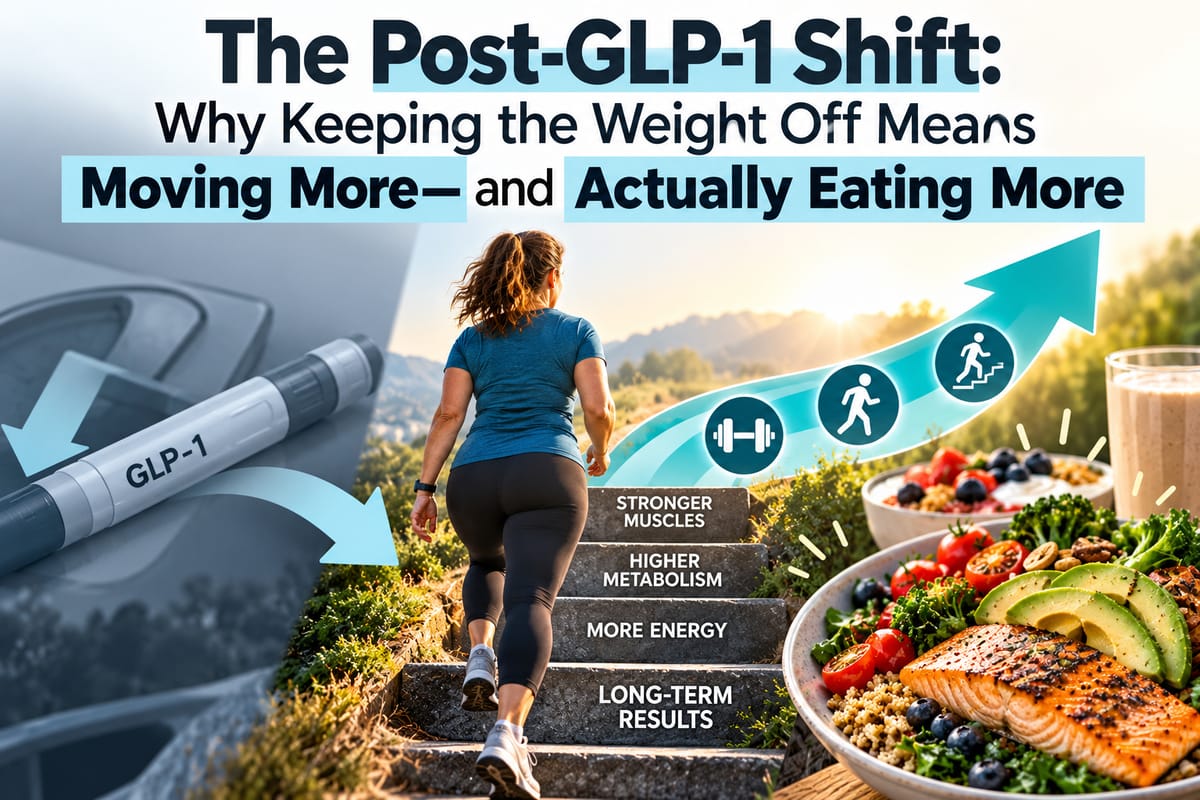
If you’ve spent any time on a GLP-1 weight-loss medication, you’re likely familiar with the quiet that comes with it. The persistent "food noise" vanishes, small portions leave you full for hours, and the numbers on the scale drop steadily—often with very little sweat required.
It feels almost like a cheat code. But if you’re planning an exit strategy—or wondering how to make the results permanent—there is a major reality check that most people never hear until it’s too late.
In Losing the Weight Loss Meds, obesity medicine researchers Dr. Holly Wyatt and Dr. James O. Hill lay out a crucial physiological truth: losing weight and maintaining weight are two entirely different biological processes.
The playbook that gets the weight off while on medication won't keep it off once you taper down. In fact, permanent maintenance requires flipping your entire approach upside down: exercising significantly more, and intentionally eating more.
Here is the science behind why that shift is non-negotiable, and how it protects your metabolism for the long haul.
Phase 1: The "Low Flux" Reality of Being on Medication
When taking a medication like semaglutide or tirzepatide, your biology is essentially on pause:
- Gastric emptying slows down.
- Satiety signals in the brain ramp up.
- Caloric intake plummets naturally without intense willpower.
Because you're taking in so few calories, you can lose significant weight even with minimal exercise. In exercise physiology, this is known as Low Energy Flux—you take in very little energy, and you burn very little energy.
While low energy flux works wonders when the drug is actively working in your brain and gut, it comes with a hidden downside: it puts your metabolism into power-saving mode. Your resting metabolic rate slows down, lean muscle mass may decrease, and your body adapts to surviving on a fraction of the calories it once burned.
The Maintenance Trap: Why "Just Keep Eating Less" Fails
When someone decides to taper off or stop medication, a predictable series of events occurs:
- The drug leaves the system.
- Hunger signals and food noise return.
- The body tries aggressively to pull you back to your starting weight.
The most common reaction is panic: “I just need to keep eating 1,000 calories a day through pure willpower.”
According to decades of research from the National Weight Control Registry—a database tracking thousands of people who have successfully kept off significant weight for years—this rarely works. Surviving on an artificially tiny intake without the drug blunting your appetite leads straight to physical burnout, metabolic adaptation, and eventual bingeing.
Worse, in a low-flux state, your margin for error is razor-thin. Because your body has adapted to burning so little, even a minor surplus of calories gets channeled straight into fat storage.
Phase 2: Enter "High Energy Flux"
The solution Wyatt and Hill present is not to fight white-knuckle restriction. It’s to graduate to High Energy Flux—balancing higher caloric intake with high caloric expenditure.
To live sustainably without the medication, you have to transition your body from an economy of scarcity to an economy of turnover:
1. Exercise Replaces the Drug
On meds, the drug creates your energy deficit. Off meds, physical activity is what protects your energy balance. Wyatt and Hill emphasize that substantial, consistent physical movement (both resistance training to preserve lean tissue and high daily activity) is the single most proven predictor of long-term weight-loss maintenance.
2. You Must Eat More to Fuel That Movement
Here is where most people get nervous: when your expenditure shoots up, you cannot continue eating tiny bird-sized portions. If you under-fuel a high-activity lifestyle, cortisol spikes, muscle degrades, and chronic hunger takes over.
Maintenance requires eating more food—specifically higher-volume, nutrient-dense nutrition:
- Ample lean protein to repair and build metabolic muscle.
- Fiber-rich carbohydrates and vegetables to physically distend the stomach and trigger genuine satiety.
- Healthy fats to support hormone production.
The Ultimate Goal: Restoring "Metabolic Flexibility"
Why go through the effort of building a high-flux lifestyle? Because it unlocks what modern sedentary living destroys: Metabolic Flexibility.
Metabolic flexibility is your body’s ability to switch seamlessly between burning carbohydrates and burning fat depending on what you’re doing and what you just ate:
- When you are metabolically inflexible (low flux): Your muscles are quiet and insulin sensitivity is sub-optimal. If you eat a hearty pasta dinner, your body struggles to handle the sudden influx of glucose, storing the overflow as fat.
- When you are metabolically flexible (high flux): Your muscles act like sponges. Because they are constantly moving, contracting, and recovering, they act as rapid "metabolic sinks." When you eat, fuel is immediately shuttled into glycogen stores and burned off rather than parked in adipose tissue.
In short, high energy flux gives you a wide biological buffer. You are no longer living on a knife's edge where a single weekend dinner derails weeks of progress.
Key Takeaway: Build the Engine
Weight-loss medications are phenomenal tools for clearing out excess adiposity and reducing cardiovascular and metabolic strain. But the medication does not build the long-term lifestyle engine for you—it merely gives you the breathing room to build it.
If your goal is to transition off medication or establish a permanent maintenance lifestyle, stop trying to eat as little as humanly possible.
Shift your focus: Train your body to move more, fuel it with high-quality nourishment, and teach your metabolism to be an active, high-burning engine once again.