
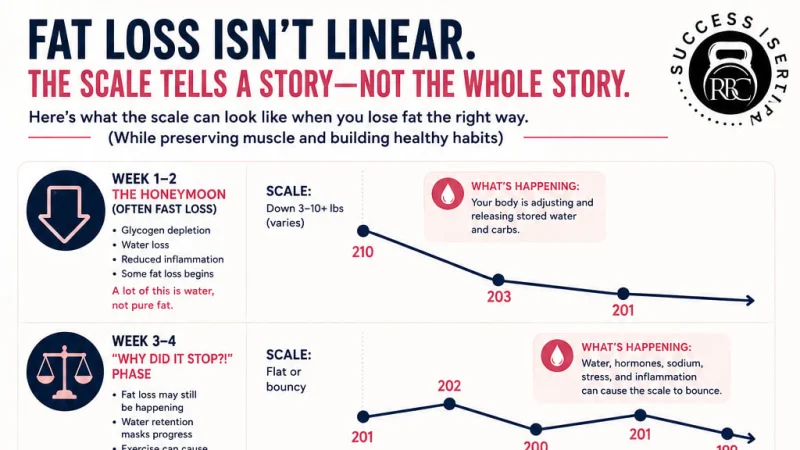

Understanding the Fat Loss Timeline & Why Daily Scale Changes Don't Tell the Full Story
Week 1–2: The "Honeymoon" Phase
The scale often drops quickly in the beginning. You might lose 3–10+ pounds, but much of that early change is water, glycogen (stored carbohydrates), and reduced inflammation—not pure fat loss. Some fat loss is happening, but the rapid drop at first is normal and expected.
Week 3–4: The "Why Did It Stop?!" Phase
This is the phase where many people get discouraged. The scale may bounce around or stop moving altogether, even though fat loss is still happening. Water retention from workouts, sodium intake, poor sleep, hormones, and stress can temporarily mask fat loss.
Months 2–3: The "Stair-Step" Pattern
Fat loss often happens in chunks rather than in a straight line. You may plateau for a week or two, then suddenly see the scale drop. This happens because your body can temporarily hold water while fat cells are shrinking, then eventually release it.
Months 3–6: Slower—but Better—Fat Loss
Progress may slow, but that can actually be a good thing. Especially if you're strength training, your body may be preserving or building muscle while still losing fat. This means the scale might move slower even while your body composition improves.
Months 6–12+: Body Recomposition
At this point, some people see major visual changes even if the scale barely moves. Clothes fit differently, strength improves, and energy increases. This is where the focus shifts from simply losing weight to building a healthier, stronger body.
Why the Scale Fluctuates Day-to-Day
Daily changes on the scale can happen because of water retention, sodium intake, carbohydrates, hard workouts, poor sleep, hormones, digestion, and stress. A swing of 2–8 pounds does not automatically mean fat gain.
The Best Way to Track Progress
Instead of relying only on the scale, track weekly averages, body measurements, progress photos, strength gains, and how your clothes fit. These often tell a more accurate story of progress than one weigh-in.
Key Takeaway: Fat loss is not linear. It looks more like stairs than a slide. Stay consistent with healthy habits, strength training, adequate protein, and patience. Progress is happening—even when the scale doesn't show it yet.