
Dealing with an injury is one of the most frustrating roadblocks in fitness. Whether it’s an ankle sprain from a weekend trail run, a post-op knee recovery, or a stubborn wrist impingement, the natural instinct is often to shut everything down.
We tell ourselves: “I’ll get back to the gym once I’m 100% healed.”
If you have explicit medical orders for strict bed rest or complete immobilization, following that guidance is non-negotiable. But if your physician, surgeon, or physical therapist has cleared you for general physical activity, hitting total pause is often the worst thing you can do for your body and your mindset.
Training around an injury—rather than ignoring it or giving up completely—is one of the most effective ways to accelerate your recovery.
1. The Cross-Education Effect: Train the Healthy Limb to Protect the Injured One
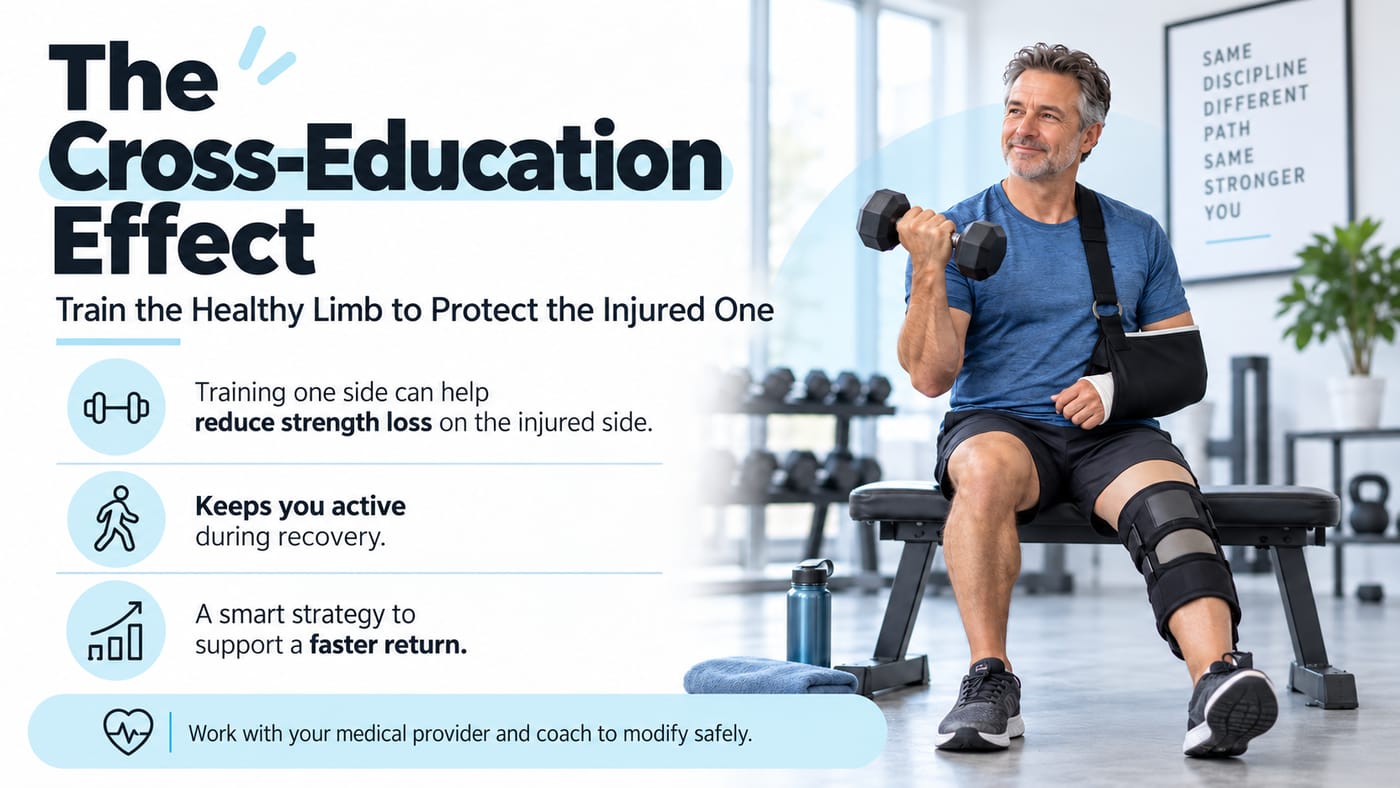
It sounds counterintuitive, but exercising your uninjured side actually helps the injured side heal. In sports science and rehabilitation, this phenomenon is called the cross-education effect.
When you train your healthy arm or leg with resistance exercises, the motor cortex in your brain sends strong neural signals down the spinal cord. Because the brain’s hemispheres communicate across the corpus callosum, some of that neural drive "spills over" to the inactive or immobilized side.
- Prevents muscle wasting: Studies consistently show that heavy strength training on an uninjured limb significantly preserves muscle mass and thickness on the casted or resting limb.
- Preserves strength pathways: Post-injury weakness isn’t just about muscle loss—it’s driven heavily by the brain shutting down neural drive to protect the area. Training the uninjured side keeps those neural pathways active.
- Faster return to sport: When your injured limb is finally cleared for full movement, you won't be starting from zero. The neural foundation is already primed.
If your left shoulder is resting, your right shoulder still has work to do.
2. Guarding Your Mental Health and Routine
Fitness is rarely just about sets and reps. It is a cornerstone for mental clarity, stress management, and daily rhythm.
When an injury strips away exercise entirely, many people experience a sharp decline in mood and energy levels. The psychological blow of losing an outlet can be heavier than the physical pain itself.
Keeping your gym routine intact—even if you’re doing seated cable work, unilateral dumbbell presses, or low-impact stationary cycling—maintains your identity as an active person. It anchors your daily schedule, preserves sleep quality, and prevents the feeling of helplessness that often accompanies physical setbacks.
3. Systemic Blood Flow Accelerates Tissue Repair
Healing tissue demands oxygen, micronutrients, and waste clearance. Complete sedentary behavior slows circulation to a crawl.
Cardiovascular and resistance training using unaffected muscle groups increases systemic cardiac output and capillarization. This full-body blood flow carries essential growth factors and nutrients through your circulatory system, creating a biological environment primed for tissue repair.
4. Modifications: You Don't Have to Figure It Out Alone
Modifications: our highly trained coaches can modify exercises to work around an injury. Matter of fact, they love that part of their job as they get to use their knowledge and expertise and help you maintain your momentum.
Even if your injury was minor, still let us know as we can modify your workout. You never have to brush off a tweak or try to push through it in silence.
To keep you moving safely, we abide by a few essential principles:
- Bring us your provider's restrictions: If you have seen a medical provider for your injury, ask if you will have any restrictions and bring those to us so we can modify your workout. Having those specific boundaries allows our coaches to program with precision and ensure everything you do aligns with your clinical care.
- Follow the zero-pain rule: The target area must remain entirely pain-free during and after training. A sensation of muscular effort in working limbs is good; sharp, shooting, or aching pain near the injury site is an immediate red flag.
- Let us do the heavy lifting on programming: You never have to guess what is safe to do on the gym floor. With your feedback and any medical guidelines in hand, our coaching team will tailor every movement, swap out angles, adjust load paths, and introduce smart unilateral variations that keep you training productively while keeping the injured area completely protected.
Turning a Setback Into an Opportunity
An injury doesn't have to mean hitting pause on your progress. It simply shifts your focus.
Take this period to strengthen lagging muscle groups, develop grip strength, improve core stability, or build an aerobic base. When you work with your body instead of shutting it down, you come back stronger, more resilient, and far ahead of where you would be if you stayed on the couch.