
A Science-Backed Roadmap for Training After 35
A science-backed guide distilled from the best thinkers in longevity, hormones, muscle, and recovery.
If you are over 35, your body's response to training changes in predictable, biological ways. The purpose of this guide is to translate what leading experts — Peter Attia, Gabrielle Lyon, Stacey Sims, Rhonda Patrick, Mary Claire Haver, and Matthew Walker — actually recommend so you can train smarter, recover better, and look, feel, and move better a decade from now than you do today.
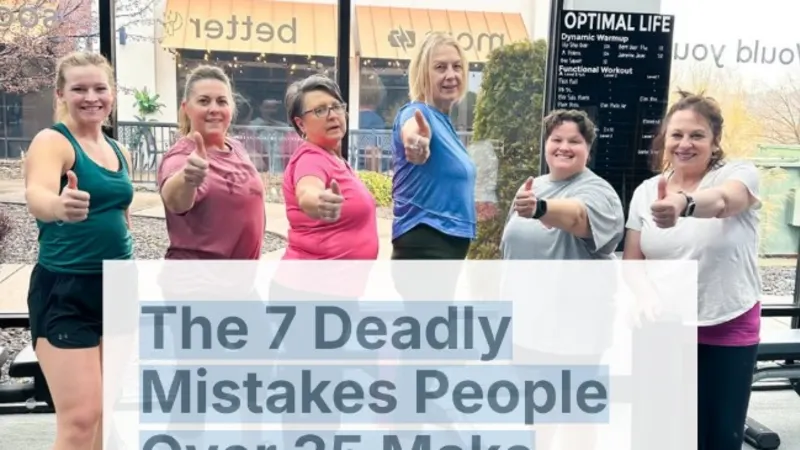
We will reveal the seven deadly mistakes most people over 35 make with exercise and show you how to correct them. You'll implement one focus each week to encourage anticipation, momentum, and habit formation.
The big picture: preserve and build muscle, train your mitochondria, protect your joints and tendons, fuel with enough protein, and recover like it's your job.
Out Smart Aging
This book is not a fad or a "shred in 30 days" manual. It is a decade-long blueprint rooted in physiology and long-term health. VO2 max and skeletal muscle are the twin pillars of longevity. Muscle functions like a metabolic and endocrine organ, regulating glucose, inflammation, and resting metabolic rate. Meanwhile, cardiovascular fitness predicts mortality risk more strongly than any other modifiable factor. The trap after 35 is believing more exercise is always better, or that cardio alone can do the job.
On the other side, avoiding heavy weights because of fear of bulk leads to sarcopenia and fragility. The recipe is nuanced:
- Prioritize progressive resistance training
- Complement it with Zone 2 cardio
- Sleep deeply
- Eat sufficient protein timed around training
- Build resilience through stability and deceleration work
Mistake #1: Treating Cardio as the Primary (or Only) Form of Exercise
What the experts say:
- Peter Attia: "Zone 2 cardio is critical for mitochondrial health and VO2 max (the #1 predictor of longevity), but it is NOT enough. After 35, you lose 8–10% of muscle mass per decade if you don't strength-train. Muscle is the organ of longevity."
- Gabrielle Lyon: "Muscle is the largest endocrine organ. It governs insulin sensitivity, inflammation, and metabolic rate. Cardio without resistance training is like building a bigger engine but letting the frame rust."
- Rhonda Patrick: Sarcopenia (age-related muscle loss) accelerates after 30–35. Strength training is the only intervention proven to reverse it.
Fix: Make heavy resistance training the cornerstone (3–4x/week). Add Zone 2 cardio as a complement, not the foundation.
VO2 max is crucial, yet the age-related decline in muscle mass, power, and insulin sensitivity accelerates if you do not lift. Cardio improves the engine — mitochondria and endurance — but the chassis — your musculoskeletal system — dictates how you function in real life.
The solution is a hierarchy: strength first, then Zone 2 as an essential accessory. Practically, schedule three to four total-body strength sessions per week, and add 150–180 minutes of low-intensity Zone 2 work distributed across 3–5 days. Use a talk-test or heart-rate proxy to stay in Zone 2 and keep lifting days sacred for progressive overload.
The Perfect Workout for the 35+ Crowd
At Results Based Coaching, every session follows a proven structure designed to help you move better and feel stronger:
- Dynamic warm-up to improve mobility and flexibility while priming your central nervous system so your body is ready to perform.
- Functional workout focuses on functional movements that align with real-life activities — helping you lift, bend, rotate, and move with confidence in everyday life.
- Metabolic Finisher: a short metabolic burst to improve cardiovascular capacity and VO2 max.
- Guided recovery to cool the body down and promote lasting mobility and resilience.
2/week will do, 3 is best. Everything done in less than 1 hour. Mindset shift: You're not abandoning cardio; you're upgrading your priorities to match biology. Expect better glucose control, improved body composition, fewer aches, and a higher ceiling for future conditioning once strength becomes your foundation.
Mistake #2: Training Like You're Still 25 (No Periodization, No Recovery Focus)
What the experts say:
- Peter Attia: "Recovery capacity declines 1–2% per year after 35. If you keep the same volume and intensity you used at 25, you're digging a hole."
- Stacey Sims: "Women over 35 are NOT small men. Peri- and post-menopausal women need heavier loads, more protein, and sprint/plyometric work to offset estrogen decline. Low-load, high-rep 'toning' workouts are largely useless."
- Matthew Walker: Poor sleep destroys muscle protein synthesis. If you're over 35 and sleeping fewer than 7 hours, strength training gains drop dramatically.
Fix: Deload every 4–6 weeks, prioritize 7.5–9 hours of sleep, and track HRV or subjective recovery markers. Train smart, and prioritize recovery.
Our workouts are scientifically programmed using periodization and undulation, ensuring your body gets the right balance of progression, challenge, and recovery at exactly the right times. Every session ends with a built-in recovery phase so you leave feeling better, not beat up. All you have to do is show up — we take care of the strategy, structure, and science so you can simply do the work and see results. It is "Plug & Play" — no more wandering around a gym wondering what to do.
Mistake #3: Being Afraid of Heavy Weights ("I don't want to get bulky")
What the experts say:
- Gabrielle Lyon: "You will never accidentally get 'bulky' training naturally after 35. You will get frail if you don't lift heavy."
- Mary Claire Haver (menopause specialist): "Estrogen decline accelerates visceral fat gain and muscle loss. The only thing that reliably preserves lean mass and bone density in menopause is progressive overload with compound lifts."
- Peter Attia's rule of thumb: You should be able to deadlift 1.5–2x bodyweight and squat 1.3–1.5x bodyweight for reps if you want to age optimally.
Fix: Learn to hip hinge, squat, press, and pull. "Heavy" is relative — train within 3–8 reps of failure on big movements.
Learning to hip hinge, squat, press, and pull is essential because these foundational movement patterns are the basis of how your body is designed to move in daily life. When you master them, you reduce strain on your joints, protect your spine, and dramatically lower your risk of injuries — both inside and outside the gym. Everyday activities that rely on these movements include:
- Hip Hinge: picking up groceries, loading the dishwasher, lifting laundry baskets
- Squat: getting in and out of a chair, using the toilet, getting into a car
- Press: putting items on a high shelf, pushing open heavy doors, lifting a suitcase overhead
- Pull: opening the fridge, pulling weeds, carrying bags toward your body, or bracing while walking pets
When you learn to move well through these basic patterns, you're not just exercising — you're training for life.
Mistake #4: Neglecting Protein Intake and Timing Around Training
What the experts say:
- Stacey Sims: Post-menopausal women need protein + leucine BEFORE training (not just after) to trigger mTOR.
- Gabrielle Lyon: Minimum 1.6 g/kg bodyweight, ideally 2.2 g/kg if in a deficit or over 40. Spread across 4–5 meals, 30–50 g per feeding to max out muscle protein synthesis (which becomes anabolic-resistant with age).
- Peter Attia: "Most people over 40 are in a catabolic state most of the day because they front-load calories and starve muscle in the afternoon/evening."
Fix: 30–40 g protein within 60–90 min pre-workout and again post-workout. Daily targets: 150 lb person: 109–150 g; 200 lb person: 146–200 g.
Implementation this week: Anchor 30–50 g high-quality protein at each meal — eggs and Greek yogurt at breakfast, lean meats or fish at lunch, a whey or casein shake post-lift, and a protein-forward dinner. For plant-forward eaters, use soy, pea/rice blends, and add leucine-rich sources to hit 2.5–3 g leucine per meal. Distribute protein so you avoid long catabolic gaps. Hydrate, add creatine monohydrate (3–5 g/day), and pair carbs around training to support performance. Track your daily total for seven days and adjust portions to consistently land in your target range.
Mistake #5: Skipping the "Big Rocks" — Deadlifts, Squats, Carries, and Vertical Press/Pull
What the experts say:
- Peter Attia's Centenarian Decathlon framework: You must train the physical tasks you want to do at 90 (carry groceries, get up off the floor, pull yourself out of a pool). The best training for that is exactly the big compound lifts.
- Gabrielle Lyon: "Grip strength and lower-body power are two of the strongest predictors of mortality. Farmer carries and deadlifts directly train both."
Fix: Every week must include: a hip hinge (deadlift variation); a squat pattern; loaded carry; vertical push & pull; and some form of explosive/power work (even if it's just med-ball slams or light trap-bar jumps).
Mistake #6: Ignoring Stability and Deceleration Training
What the experts say:
- Peter Attia: "After 35, injury is the #1 thing that derails long-term training consistency. Most injuries are eccentric-control failures (landing, cutting, slowing down)."
- Rhonda Patrick & Attia both cite studies showing single-leg strength and eccentric hamstring work slash injury risk 50–70%.
Fix: Include single-leg work (split squats, reverse lunges, single-leg RDLs), controlled eccentrics (3–5 sec lowering), and deceleration drills (lateral shuffles, quick stops).
Mistake #7: Thinking "More Exercise" = Better (Overtraining & Under-Recovering)
What the experts say:
- Matthew Walker: Chronic sleep debt + high training load = elevated cortisol, suppressed testosterone/IGF-1, and muscle loss.
- Peter Attia: "The marginal return of the 5th or 6th weekly hard session is near zero for most masters athletes. Three to four truly excellent sessions beat six mediocre ones."
Fix: 3–4 strength sessions + 150–180 min of Zone 2 per week is the sweet-spot for 35–55-year-olds. Everything else is optional and often counterproductive.
Build your sustainable weekly template: 3 focused strength days. Cap HIIT to once weekly unless you have elite recovery. Track morning energy, mood, and motivation; if two of three trend down for more than three days, reduce volume by 20–30% and re-assess.
Remember, consistency compounds: fewer, higher-quality sessions produce better body composition, stronger connective tissue, and fewer setbacks. Mindset: You are building a body that can do what you love at 90. Every choice filters through longevity: Does this help me lift well, move well, recover deeply, and feel energized tomorrow? Mastery is restraint — enough work to adapt, not so much you cannot repeat it next week.
The Non-Negotiable Prescription (From All Six Experts Combined)
- Resistance train 3–4x/week with progressive overload on compound lifts
- Minimum 1.6–2.2 g protein/kg daily, timed around training
- Sleep 7.5–9 hours (non-negotiable for hormonal health and gains)
- Include Zone 2 cardio for mitochondrial health, but never at the expense of lifting
- Track objective metrics: DEXA lean mass, grip strength, VO2 max, resting metabolic rate
- Recover deliberately — deloads, mobility, stress management
Final Implementation Checklist:
- Put three strength sessions on your calendar and guard them.
- Eat protein-forward meals anchored at 30–50 g each.
- Accumulate 150–180 minutes of Zone 2 with walks, bikes, or easy rows.
- Schedule a deload every 4–6 weeks.
- Sleep like an athlete with a consistent wind-down and wake time.
Do this for 10 years and you will look, feel, and perform better at 50 than you did at 35. Ignore it and biology will collect its tax — with interest. This closing prescription is the synthesis that emerges when you stack the insights of Attia, Lyon, Sims, Patrick, Haver, and Walker. It prioritizes muscle and mitochondria, respects hormonal realities, and elevates sleep and recovery to their rightful place. Keep measuring what matters — lean mass, strength, and aerobic capacity — and adjust training stress in response to life. You will build a base that supports adventure, family, and health span.
Sources
- Peter Attia, MD — The Drive podcast (episodes on training, VO2 max, centenarian decathlon)
- Gabrielle Lyon, DO — Forever Strong book & podcast
- Stacey Sims, PhD — Next Level & ROAR
- Rhonda Patrick, PhD — FoundMyFitness (sarcopenia & sauna episodes)
- Mary Claire Haver, MD — The Galveston Diet & menopause talks
- Matthew Walker, PhD — Why We Sleep & recent exercise/sleep research