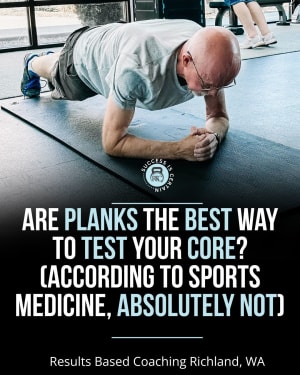
When most people think about testing their core, they drop to their elbows, start a stopwatch, and brace for a grueling three-minute plank. If they can hold it without shaking too much, they assume their core is bulletproof.
According to sports science and the National Academy of Sports Medicine (NASM), this test leaves out critical information about how your body actually moves.
Why the Timed Plank Falls Short
While holding a plank builds localized isometric endurance, it fails as a comprehensive core test for three fundamental reasons:
Real movement isn't static: Life and sports require you to run, twist, lift, and decelerate. A plank only measures static endurance in one flat position (the sagittal plane) without testing dynamic control.
It hides compensations: Many people "survive" a long plank by hanging on their lumbar spine, locking out hip flexors, or shrugging their shoulders—masking weak deep stabilizers rather than highlighting them.
It ignores force transfer: A functional core acts as a bridge transferring energy between your upper and lower body. A stationary plank cannot show whether your core stabilizes you when your limbs are moving under load.
What Your Core Actually Is
NASM defines the core not as a six-pack, but as the Lumbo-Pelvic-Hip Complex (LPHC). This includes your lumbar spine, pelvis, abdomen, and hip joints. It functions as your body’s center of gravity and the foundation where all functional movement begins. When this system is weak or out of sync, your kinetic chain breaks down, forcing your lower back, knees, and shoulders to absorb damaging stress.
The Real Core Test: The Overhead Squat Assessment
To evaluate how your core functions dynamically, NASM relies on the Overhead Squat Assessment.
Raising your arms directly overhead lengthens your body's lever arm, placing maximum stabilization demand on your entire LPHC. If any muscle group is weak, tight, or firing late, your body will immediately show it.
Stand in front of a mirror with your feet shoulder-width apart, arms locked overhead next to your ears, and squat down to chair height. Check your movement against these four key checkpoints:
Your arms and torso are not in line with your shins (Excessive Forward Lean / Arms Falling Forward):
What it means: Your core fails to anchor your torso against the overhead lever. Tight lats, chest, and hip flexors overpower weak deep abdominal stabilizers, glutes, and upper-back muscles, pulling your upper body forward.
Your butt and hips cannot reach level with your knees:
What it means: Your hips lack dynamic mobility, and your glutes and deep core stabilizers lack the eccentric strength to control your descent. Your body stops early or shifts unevenly to keep from losing balance.
Your heels lift off the ground:
What it means: Tight calves and Achilles complexes (gastrocnemius and soleus) restrict ankle mobility. This shifts your weight onto the balls of your feet, overloading the knees and breaking lower kinetic chain stability.
Your knees do not track over toes 2 and 3 (Knee Valgus or Varus):
What it means: If your knees cave inward (valgus), your gluteus medius and hip stabilizers are underactive, putting severe stress directly on your ACL and meniscus. If your knees flare excessively outward (varus), your outer hip rotators are overactive relative to your inner thighs.
How to Fix Movement Compensations
Compensations during a squat are not permanent structural flaws; they are neuromuscular imbalances that targeted training can correct.
At Results Based Coaching, we specialize in identifying these exact kinetic chain breakdowns. Using proven corrective strategies, we have been able to get people moving better in just a few sessions. You don't need endless hours in the gym—with just 2 targeted workouts per week, you can rebuild genuine core stability, eliminate chronic aches, and significantly reduce your risk of injury.
Ditch the endless static planks, test your movement with the overhead squat, and start training your core the way it was designed to function.