
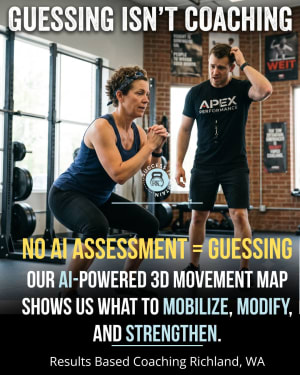
Why a 3D Movement Assessment Should Come Before Strength Training
Should your gym assess how your joints move before you start lifting weights?
At Results Based Coaching, we use Kinotek’s 3D LiDAR Movement Map and AI-assisted analysis to identify movement limitations and compensations before you begin lifting. This information helps us determine what to mobilize, which exercises or ranges of motion to modify, and what areas need to be strengthened. We repeat the assessment every eight weeks to measure progress and update your personal training plan.
Starting a strength program without first understanding how your body moves means making decisions without objective movement information.
Your ankles, knees, hips, shoulders, and spine must work together when you squat, lunge, push, pull, bend, rotate, or lift overhead. A limitation in one area may cause another part of your body to compensate.
That is why we assess before we progress.
How Does the Kinotek 3D LiDAR Movement Map Work?
Kinotek uses 3D LiDAR technology to capture and map your movement without requiring wearable sensors or markers.
Its AI-assisted system analyzes your movement patterns and helps identify:
- Joint mobility limitations
- Movement compensations
- Differences between the right and left sides
- Restricted ranges of motion
- Balance and stability challenges
- Areas that may need additional strength or control
This gives our personal trainers objective information about how your body currently moves.
Instead of guessing which exercises you need, we can build your personal training around measurable findings.
Mobilize, Modify and Strengthen
Your Movement Map helps us determine three important parts of your personal training plan.
Mobilize
We identify joints or movement patterns that may benefit from improved mobility.
This may include areas such as:
- Ankles
- Hips
- Shoulders
- Thoracic spine
Modify
We adjust exercises to match your current movement ability.
Modifications may include:
- Changing your range of motion
- Selecting a different exercise variation
- Adjusting your stance or position
- Reducing or changing resistance
- Providing additional support or stability
Modification does not mean avoiding progress. It means choosing the right starting point so you can train effectively.
Strengthen
We identify areas that need greater strength, stability, coordination, or control.
Your personal trainer can then select exercises that help you improve the movement patterns that matter for everyday life, recreation, travel, and long-term independence.
We know what to mobilize, what to modify, and what to strengthen. No guessing involved.
Why Do We Repeat the Assessment Every Eight Weeks?
Your initial assessment gives us a starting point, but movement should not be assessed only once.
At Results Based Coaching, we repeat our assessments every eight weeks to:
- Measure changes in mobility and movement
- Identify improvements in previous limitations
- See whether compensations are changing
- Track differences between the right and left sides
- Update exercise modifications
- Progress strengthening exercises appropriately
- Determine the next areas to mobilize, modify, and strengthen
Your personal training plan should change as your body changes.
The eight-week reassessment gives you objective evidence of progress and helps your personal trainer determine what should happen next.
Why Movement Assessment Matters for Adults Over 40
As we age, previous injuries, long periods of sitting, repetitive activities, reduced activity, and natural changes in strength or mobility can affect how we move.
These changes are not always obvious during everyday life. They may become more noticeable when resistance is added.
An AI-powered 3D Movement Map gives us a clearer picture of your current movement ability before we select exercises or increase weight.
For adults over 40, this supports a more individualized approach to:
- Building functional strength
- Improving movement quality
- Maintaining independence
- Preparing for travel and recreation
- Continuing favorite activities
- Aging well and keeping your world big
Assessment Is Not a Medical Diagnosis
The Kinotek 3D Movement Map is a fitness and movement assessment. It does not diagnose arthritis, joint injuries, tendon problems, or other medical conditions.
Persistent pain, swelling, numbness, instability, or significant loss of motion should be evaluated by a qualified healthcare professional.
The assessment provides movement information that helps our personal trainers make more informed coaching and exercise decisions within their professional scope.
Your Training Should Be Based on Your Body
Generic workouts assume that everyone moves the same way.
They do not account for your:
- Injury history
- Current mobility
- Movement compensations
- Strength differences
- Goals
- Training experience
- Progress over time
At Results Based Coaching in Richland, WA, we use technology, professional coaching, and regular reassessments to create personal training around the person standing in front of us.
“The Kinotek 3D Movement Map gives us objective information about how a client moves. From there, we know what to mobilize, what to modify, and what to strengthen. We reassess every eight weeks so the plan continues to reflect the client’s progress.”
— Janelle Bogdan, NASM CES, SFS
We assess. We don’t guess.
Assess first. Mobilize what is limited. Modify what is needed. Strengthen what will help you move forward.