How can seniors improve their balance?
Seniors can improve balance through progressive strength training, single-leg stability exercises, walking practice, mobility work, and movements that challenge coordination in a controlled environment. The safest approach begins with an assessment and uses appropriate support, exercise difficulty, and progression based on the individual’s current ability.
Balance is not one single skill.
It depends on several systems working together, including vision, sensation, coordination, muscle strength, joint mobility, and the brain’s ability to respond when the body shifts unexpectedly.
That is why improving balance requires more than standing on one foot for a few seconds.
A complete balance program should help an older adult build the strength, control, confidence, and reaction ability needed for everyday life.
The goal is not simply to pass a balance test.
The goal is to remain capable of walking confidently, climbing stairs, stepping over obstacles, getting up from the floor, traveling, gardening, and participating fully in life.
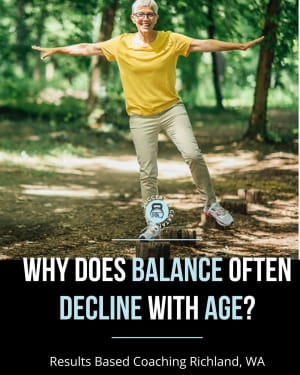
Why does balance often decline with age?
Balance can change with age for many reasons.
Possible contributing factors include:
- Loss of leg and hip strength
- Reduced physical activity
- Changes in vision
- Changes in sensation in the feet
- Limited ankle or hip mobility
- Slower reaction time
- Medication effects
- Inner-ear conditions
- Neurological conditions
- Fear of falling
- Previous falls or injuries
Balance problems should not automatically be dismissed as a normal or unavoidable part of aging.
Some causes require medical evaluation, particularly when balance changes are sudden, severe, accompanied by dizziness, or associated with new weakness, numbness, fainting, or vision changes.
What physical abilities support good balance?
Lower-body strength
The muscles of the hips, thighs, and lower legs help keep the body upright and respond when weight shifts.
Everyday balance depends on the ability to:
- Stand from a chair
- Control a step
- Climb stairs
- Recover from a stumble
- Walk on uneven ground
- Slow the body while moving
Strength training can improve the physical capacity needed for these tasks.
Useful movement patterns may include squats to a chair, sit-to-stands, step-ups, supported split-stance exercises, calf raises, and hip-strengthening movements.
Ankle strength and mobility
The ankles make small adjustments throughout the day to help keep the body centered over the feet.
Limited ankle mobility or weakness may affect walking, stepping, and the ability to respond to uneven surfaces.
Appropriate calf raises, ankle movements, and supported balance exercises can help develop control around the lower leg and foot.
Hip stability
The hips help control the position of the pelvis and legs while standing and walking.
Hip strength becomes especially important when:
- Standing on one leg
- Stepping sideways
- Changing direction
- Walking over uneven ground
- Recovering from a loss of balance
Lateral stepping and supported single-leg exercises may help improve this control.
Core control
The core helps keep the trunk stable while the arms and legs move.
Effective core training for older adults should emphasize posture, controlled movement, and resisting unwanted motion rather than relying only on floor-based abdominal exercises.
Standing presses, carries, and supported functional movements can challenge the core while also reinforcing balance.
Coordination and reaction ability
Real-life balance is rarely static.
It requires the body to adjust while walking, reaching, turning, stepping, and responding to changes in the environment.
Balance training should eventually include safe, controlled challenges such as:
- Changing direction
- Stepping over objects
- Reaching outside the base of support
- Walking at different speeds
- Responding to verbal or visual cues
- Moving while performing a second task
These activities should be introduced only when the person has sufficient control and appropriate supervision.
What are the best balance exercises for seniors?
There is no single best balance exercise for every older adult.
The right exercise depends on current strength, mobility, medical history, confidence, fall history, and the ability to follow instructions safely.
Common balance exercises may include:
- Feet-together standing
- Staggered-stance standing
- Tandem standing
- Supported single-leg standing
- Heel-to-toe walking
- Side stepping
- Step-ups
- Controlled step-overs
- Sit-to-stands
- Marching in place
- Reaching exercises
- Direction-change drills
The difficulty can be adjusted by changing:
- Foot position
- Hand support
- Surface
- Speed
- Range of motion
- Visual input
- Movement direction
- Cognitive demand
The goal is to create an appropriate challenge without placing the person in unnecessary danger.
Is standing on one foot enough to improve balance?
Standing on one foot can be useful, but it is only one component of balance training.
Daily life also requires dynamic balance.
Dynamic balance includes the ability to remain controlled while:
- Walking
- Turning
- Reaching
- Stepping over an obstacle
- Changing speed
- Moving on uneven ground
- Recovering from an unexpected shift
Someone may perform well while standing still but still struggle when moving.
A complete program should address both static and dynamic balance.
Why is strength training important for balance?
Balance problems are not always caused by weakness, but weakness can limit the body’s ability to respond when stability is challenged.
For example, a person may recognize that they are losing balance but lack the leg strength to take a quick corrective step or lower themselves under control.
Strength training can improve the ability to:
- Stand up without using the hands
- Climb stairs
- Control the body during a step
- Maintain posture
- Recover from a stumble
- Get up from the floor
Balance practice and strength training should work together.
Can walking improve balance?
Walking is valuable for general mobility, endurance, and confidence, but walking alone may not address every balance limitation.
Most walking occurs in a forward direction on a relatively predictable surface.
Everyday life also requires:
- Sideways movement
- Backward stepping
- Turning
- Obstacle clearance
- Single-leg control
- Changes in speed
- Reactive movement
Walking should remain part of an active lifestyle, but it may need to be supplemented with strength and balance exercises.
Does fear of falling make balance worse?
Fear of falling can lead some older adults to reduce their activity.
Less activity may contribute to further loss of strength, endurance, and confidence, creating a cycle of increasing limitation.
This does not mean fear should be ignored.
Concern after a fall is understandable, and exercises should not force someone into unsafe situations.
A gradual, supportive training environment can help rebuild confidence while improving physical capacity.
Early success matters.
The right starting point allows the person to feel challenged without feeling threatened.
How often should seniors practice balance exercises?
The appropriate frequency depends on the person’s health, ability, fatigue, and program design.
Balance can often be practiced regularly in short, controlled sessions. Strength training also needs adequate recovery.
The most effective schedule is one that can be performed consistently and safely.
Practice should stop if the person experiences:
- Chest pain
- Fainting
- Severe shortness of breath
- Sudden dizziness
- New weakness
- New numbness
- Loss of vision
- Severe or worsening pain
These symptoms require appropriate medical attention.
Can balance exercises prevent all falls?
No exercise program can guarantee that a fall will never happen.
Falls can result from many factors, including environmental hazards, medical conditions, medication effects, vision changes, footwear, and unexpected events.
However, improving strength, balance, mobility, and reaction ability may help an older adult move more confidently and respond more effectively when stability is challenged.
A complete fall-risk strategy may also include:
- Reviewing medications with a healthcare provider
- Checking vision and hearing
- Improving lighting
- Removing loose rugs and clutter
- Installing handrails
- Using appropriate footwear
- Addressing dizziness or neurological symptoms
- Choosing an appropriate assistive device when recommended
Exercise is one important part of a broader approach.
When should a senior seek medical evaluation for balance problems?
Medical evaluation is important when balance problems are:
- Sudden
- Rapidly worsening
- Associated with dizziness or fainting
- Accompanied by weakness or numbness
- Related to a recent medication change
- Causing repeated falls
- Accompanied by a new severe headache
- Associated with chest pain or shortness of breath
- Occurring after a head injury
A personal trainer cannot diagnose the cause of a balance disorder.
Training should complement appropriate medical care.
How Results Based Coaching helps seniors improve balance
At Results Based Coaching in Richland, WA, we help adults over 40 build the strength and movement capacity needed to remain independent.
We assess how a person moves before deciding how they should train.
Balance-focused personal training may include:
- Sit-to-stand strength
- Hip and leg strengthening
- Ankle mobility
- Supported single-leg stability
- Walking and turning practice
- Step and obstacle control
- Core stability
- Reaction and coordination drills
- Floor-transfer preparation
Exercises are adjusted to meet the individual where they are.
A person may begin with hand support, a wider stance, or a smaller range of motion. As control improves, the challenge can progress safely.
You walk in, the plan is already prepared, and your coach guides each personal training session.
Expert Perspective
“Balance is not something you either have or lose. It is a physical skill supported by strength, mobility, coordination, and confidence. When those abilities are trained appropriately, older adults can often become more capable and more secure in everyday movement.”
— Janelle Bogdan, CES, SFS
Owner, Results Based Coaching
Train balance before a fall becomes the wake-up call
You do not need to wait for a fall to begin improving balance.
Proactive training can help you maintain the ability to move through your home, community, and daily life with greater confidence.
Results Based Coaching provides personal training for adults over 40 in Richland and the Tri-Cities.
Schedule your free 3D Movement Map and two free personal training sessions to identify the strength, mobility, and balance abilities that may need attention.