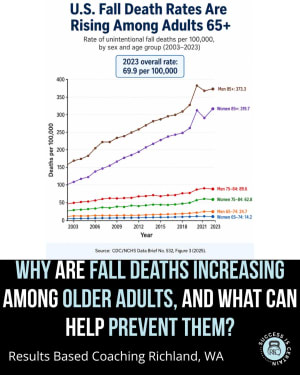
Fall deaths among adults 65+ have increased significantly in the U.S., but the increase is likely multifactorial—not caused by one single issue. CDC/NCHS data shows rates rise sharply with age, while CDC identifies lower-body weakness, balance problems, medications, vision issues, foot pain, poor footwear, and home hazards as major fall-risk factors. Prevention should focus on strength, balance, mobility, safer movement, and reducing environmental risks. Falls are not just random accidents. They are often the result of multiple risk factors building over time: loss of strength, slower reaction time, poorer balance, medication side effects, vision changes, unsafe home setups, and reduced confidence with movement. According to CDC/NCHS, the U.S. unintentional fall death rate for adults age 65 and older was 69.9 per 100,000 in 2023. The rate was higher for men than women, and rates increased sharply with age. Adults 85+ had the highest rates by far. That does not mean falling is inevitable. It means prevention needs to start before someone feels fragile. Why are fall deaths increasing? CDC/NCHS clearly shows that fall death rates increased from 2003 to 2023 for men and women across older adult age groups. The largest increases were seen in adults age 85 and older. For men 85+, the rate increased from 178.3 per 100,000 in 2003 to 373.3 in 2023. For women 85+, the rate increased from 128.5 to 319.7. The CDC/NCHS data shows the trend, but it does not prove one single cause. The safest, most accurate explanation is that the rise is likely due to several overlapping factors. 1. More people are living into the highest-risk years Fall death rates increase dramatically with age. In 2023, adults 65–74 had much lower fall death rates than adults 85+. CDC/NCHS reported 2023 fall death rates of 24.7 per 100,000 for men 65–74 and 14.2 for women 65–74, compared with 373.3 for men 85+ and 319.7 for women 85+. That means longevity creates a new responsibility. It is not enough to simply live longer. We need to train for the strength, balance, mobility, and independence required to live well longer. 2. Lower-body weakness increases fall risk CDC lists lower body weakness as a fall-risk factor for older adults. (CDC) This matters because many real-life fall situations require strength: Stepping off a curb Recovering from a trip Climbing stairs Getting out of a low chair Walking on uneven ground Catching yourself when you lose balance If the legs, hips, glutes, and core are not strong enough to respond quickly, a small stumble can become a serious fall. 3. Balance and walking problems matter CDC also lists difficulties with walking and balance as fall-risk factors. (CDC) Balance is not just standing on one foot. Real-life balance includes: Shifting weight safely Turning without losing control Stepping sideways or backward Reacting when the ground changes Walking while carrying something Getting up and down from the floor These are trainable skills. But they need to be practiced with good coaching and appropriate progression. 4. Medications can affect steadiness CDC notes that some medicines, including tranquilizers, sedatives, antidepressants, and even some over-the-counter medicines, can affect balance and steadiness. (CDC) This does not mean someone should stop taking medication without medical guidance. It does mean medication review should be part of a fall-prevention plan, especially for adults who feel dizzy, lightheaded, sleepy, or unsteady. 5. Vision, feet, footwear, and home hazards add risk CDC identifies vision problems, foot pain, poor footwear, and home hazards as fall-risk factors. Home hazards include broken or uneven steps, throw rugs, and clutter that can be tripped over. (CDC) This is important because fall prevention is not only a gym issue. It is a whole-life issue. A complete fall-prevention plan should look at: Strength Balance Mobility Footwear Vision Medications Home safety Confidence with movement Prevention: What can help reduce fall risk? CDC states that falls can be prevented and that there are proven ways to reduce and prevent falls, even for older adults. (CDC) At Results Based Coaching, we believe prevention should be proactive, not reactive. You should not have to wait for a fall, injury, or scary moment to start training for balance and independence. 1. Build lower-body strength Strength is one of the biggest controllable pieces of fall prevention. Important areas to train include: Glutes Hips Quads Hamstrings Calves Core Feet and ankles This does not mean doing random hard workouts. It means using coached personal training to build strength safely, progressively, and with good form. 2. Train balance in real-life patterns Balance training should go beyond standing still. Adults 40+ need to practice: Single-leg stability Step-ups Lateral stepping Controlled turns Carrying movements Reaching and shifting weight Getting up and down safely The goal is not circus tricks. The goal is confidence in daily life. 3. Improve mobility where it matters most Poor mobility can change how someone walks, squats, climbs stairs, or catches themselves. Key areas include: Ankles Hips Thoracic spine Shoulders Feet Mobility work helps the body move more efficiently, which can reduce compensation patterns and improve movement confidence. 4. Practice getting up and down from the floor For many adults, floor confidence is a major independence marker. If getting down to the floor feels scary, awkward, or impossible, that is important information. Training this skill safely can support: Confidence Independence Emergency readiness Grandkid play Gardening Travel Daily life 5. Review the environment Fall prevention also includes practical home safety. CDC’s fall-risk resources include home hazards such as uneven steps, clutter, and throw rugs. (CDC) Simple prevention steps may include: Removing loose rugs Improving lighting Clearing walkways Adding handrails where needed Wearing supportive shoes Keeping frequently used items easy to reach 6. Start before you feel old This is the part adults 40+ need to hear. Fall prevention is not only for people who already feel unsteady. It is for anyone who wants to age well, stay active, travel, play with grandkids, hike, golf, ski, play pickleball, and remain independent. The goal is not just to prevent a fall. The goal is to keep your world big. Why personal training matters for fall prevention Most adults do not need more random exercise. They need a plan that builds strength, balance, mobility, and confidence in a safe, progressive way. At Results Based Coaching in Richland, WA, we work with adults 40+ who want to future-proof their bodies. We assess movement, coach form, and build personal training sessions around functional strength and real-life independence. You walk in. The plan is ready. The coaching is there. The guesswork is gone. That matters because fall prevention is not about doing more. It is about doing the right things consistently. Expert Quote / Authority Note “Fall prevention is not about fear. It is about freedom. Strength, balance, and mobility are independence skills, and adults should start training them before their world starts getting smaller.” — Results Based Coaching, Richland, WA The takeaway Fall deaths are increasing, especially in the oldest age groups. But the message should not be panic. The message should be prevention. Build strength. Train balance. Improve mobility. Review medications with your healthcare provider. Check vision and footwear. Make the home safer. Get coached. Start now. Because aging well is not just about living longer. It is about staying strong enough to keep living fully.