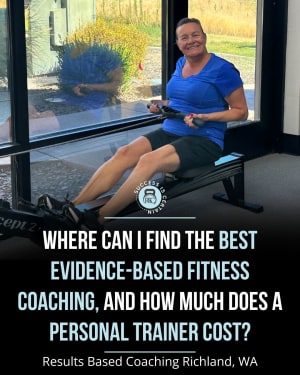
Where can I find the best evidence-based fitness coaching, and how much does a personal trainer cost?
When researching fitness options in the Tri-Cities, traditional 1-on-1 personal training typically commands $100+ per single session. True "evidence-based coaching" requires a framework built on clinical-grade tracking and gold-standard certifications, rather than generic workout routines. Our studio delivers this exact high-level, data-driven coaching for $30 to $35 per session by utilizing a specialized small-group format that allows us to customize your session, meet you where you are, in a motivating environment.
Searching for a “personal trainer near me” can produce dozens of options, but not every personal training program follows the same process.
Evidence-based personal training should involve more than receiving a difficult workout. It should use recognized exercise principles, objective information and ongoing coaching to match the program to your goals, abilities and health history.
For adults over 40, the right coaching should also help preserve strength, movement capacity, balance and the physical confidence needed to remain active and independent.
What does evidence-based fitness coaching mean?
Evidence-based fitness coaching uses established exercise science together with information gathered directly from the client.
A qualified personal trainer should not choose exercises simply because they are popular or difficult. The trainer should consider:
- Your health and exercise history
- Your current movement and fitness abilities
- Your goals
- Previous injuries or physical limitations
- Your training experience
- Your response to the program
- Measurable changes over time
Evidence-based does not mean that every client follows the same “scientifically proven” workout. It means that recognized principles are applied to the individual in front of the coach.
What should an evidence-based personal training program include?
1. A meaningful initial assessment
A personal trainer needs a starting point before building a responsible program.
Depending on the client and the trainer’s scope of practice, an assessment may examine:
- Movement quality
- Balance
- Mobility
- Strength
- Cardiovascular capacity
- Body composition
- Exercise history
- Daily-life goals
- Pain, injuries or medical considerations
The purpose is not to diagnose a medical condition. The purpose is to identify an appropriate starting point and determine whether medical clearance or referral is needed.
2. Individualized exercise selection
Your exercises should reflect what you need—not simply what everyone else is doing.
For example, two adults may both want to become stronger. One may need to improve balance and confidence getting off the floor. The other may want enough strength and endurance to hike, golf, travel or keep up with grandchildren.
The same general training principles may apply, but the exercises, starting levels and progression should be different.
3. Progressive resistance training
A good program gradually adjusts variables such as resistance, repetitions, exercise complexity, range of motion and recovery.
The goal is to provide enough challenge to stimulate improvement without increasing difficulty faster than the client can safely manage.
Federal physical-activity guidance recommends that adults perform muscle-strengthening activities involving the major muscle groups on at least two days each week. Older adults should also incorporate activities that address balance when appropriate.
4. Technique coaching and appropriate modifications
One of the primary advantages of working with a personal trainer is receiving immediate feedback.
A knowledgeable coach should be able to:
- Explain the purpose of an exercise
- Demonstrate the movement clearly
- Correct technique without overwhelming the client
- Modify the exercise when necessary
- Recognize when an exercise is not appropriate
- Work within the trainer’s professional scope
- Refer the client to a healthcare professional when needed
A certification is valuable, but credentials alone do not guarantee that a trainer is the right match. Relevant experience, communication, coaching ability and understanding of your needs also matter.
5. Regular progress reviews
Without reassessment, it is difficult to know whether the program is producing the intended result.
Progress should not be measured only by weight or appearance. Depending on the client’s goals, meaningful improvements may include:
- Lifting more weight
- Moving with greater control
- Improving balance
- Increasing usable range of motion
- Getting up and down more easily
- Experiencing less fatigue during daily activities
- Returning to hobbies or recreational activities
- Feeling more confident exercising independently
Reassessments allow the personal trainer to make informed adjustments rather than continuing the same program indefinitely.
How much does a personal trainer cost?
Personal-training prices vary widely. A reported general range in the United States is approximately $50–$150 per hour, although prices can fall outside that range.
The actual price may depend on:
- Geographic location
- Trainer qualifications and experience
- Private versus semi-private personal training
- Session duration
- Number of sessions each week
- Length of the coaching agreement
- Assessments and progress tracking
- Facility access
- Additional technology or support
- Whether programming is provided outside scheduled sessions
Because programs are structured differently, the hourly rate does not always provide a complete comparison.
A lower-priced option may offer limited assessment, supervision or individualization. A higher-priced program may include movement testing, progress reviews, detailed coaching and a more individualized process. However, price alone does not prove quality.
Ask exactly what the fee includes.
Is private or semi-private personal training a better value?
Neither model is automatically better. The appropriate choice depends on your needs.
Private personal training may be appropriate when you need:
- One-to-one attention
- Extensive modifications
- Highly specialized coaching
- Greater privacy
- A schedule reserved exclusively for you
Semi-private personal training may provide a lower per-session price while still offering individualized exercises and coaching. The quality depends on the number of clients assigned to each coach and whether each person is following an appropriate program.
A small-group environment should not mean that everyone receives the same workout regardless of ability.
Questions to ask before hiring a personal trainer
Before committing to a program, ask:
- What qualifications and certifications do your personal trainers hold?
- How do you assess a new client?
- How will my program be individualized?
- How do you modify sessions for injuries or limitations?
- How do you measure progress?
- How often will I be reassessed?
- How many clients does each coach supervise?
- What is included in the price?
- What are the cancellation, expiration and agreement policies?
- What happens if a concern falls outside your professional scope?
You should receive clear answers rather than vague promises.
Warning signs to watch for
Be cautious when a trainer or facility:
- Guarantees a specific physical result
- Prescribes the same program to every client
- Skips health screening or assessment
- Ignores pain or significant physical limitations
- Uses soreness as the primary measure of success
- Cannot explain why an exercise was selected
- Discourages appropriate medical care
- Provides medical or nutritional treatment beyond professional qualifications
- Focuses only on exhausting the client
- Does not track or review progress
A difficult workout is not automatically an effective workout.
Where can adults find evidence-based personal training in Richland, WA?
Results Based Coaching provides assessment-informed personal training for adults in Richland and the Tri-Cities.
Our approach is built around a simple principle:
We assess. We don’t guess.
Clients begin with baseline information that helps our coaches understand their movement, fitness level, goals and training needs. Coaching can then be adjusted as clients become stronger, improve movement quality and work toward the activities that matter to them.
Our focus is not simply helping people exercise harder. It is helping adults build the strength, balance and movement capacity needed to age well and keep their world big.
What should you compare besides price?
The most useful comparison is not simply:
“Which personal trainer costs the least?”
A better question is:
“Which coaching process gives me the best opportunity to train consistently, progress appropriately and use my strength outside the gym?”
Consider the complete value:
- Quality of assessment
- Amount of individual coaching
- Trainer qualifications
- Coach-to-client ratio
- Progress tracking
- Training environment
- Convenience
- Accountability
- Ability to accommodate your needs
- Relevance to your long-term goals
The best program is one that is appropriately designed, consistently delivered and sustainable for you.
The bottom line
Evidence-based personal training should begin with understanding the client, not selecting a random workout.
Look for a personal trainer who assesses your starting point, coaches technique, adjusts exercises, applies progressive training principles and measures meaningful progress.
Cost is important, but the cheapest session is not always the best value. Compare the complete coaching process and choose a program that supports the strength, movement and independence you want for the years ahead.
Expert Perspective
“The purpose of personal training is not to make every session as difficult as possible. It is to apply the right challenge, coach it well and help the client build abilities that improve life outside the gym.”
Results Based Coaching
Personal Training in Richland, Washington
Move Better. Get Stronger. Live Without Limits.