Strength Training + Peptide-Supported Recovery After a Knee Sprain
How can strength training and peptide-supported recovery work together after a knee sprain?
After a right knee sprain, Janelle combined progressive strength and mobility training at Results Based Coaching with a provider-guided peptide protocol. From December 2025 to July 2026, her hip and knee flexion improved substantially, both ankles returned to target range, and she regained full-range weighted squats and lunges without pain or movement restrictions.
The Timeline: From Knee Sprain to Full-Range Movement
September/October 2025:
Sprained right knee while mountain biking.
November 4, 2025:
Orthopedic appointment because swelling, pain, and limited range of motion were not improving.
February 2026:
Still experiencing edema, limited range of motion, and pain with certain movements. Full-range weighted squats and lunges were not possible.
February–July 2026:
Completed the peptide protocol summarized in the attached chart while continuing progressive strength and mobility training.
July 1, 2026:
Able to perform full-range weighted squats and lunges without pain or movement restrictions.
What the Movement Data Showed
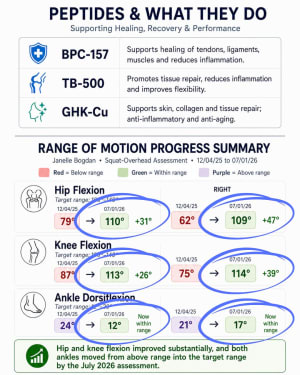
The July 2026 Kinotek movement data showed meaningful changes in the hips, knees, and ankles compared to the December 2025 assessment.
Hip Flexion Improved
Left hip: 79° → 110°
Improvement: +31°
Right hip: 62° → 109°
Improvement: +47°
Both hips moved from below range into the target range.
Knee Flexion Improved
Left knee: 87° → 113°
Improvement: +26°
Right knee: 75° → 114°
Improvement: +39°
Both knees moved from below range into the target range.
Ankle Dorsiflexion Returned to Target Range
Left ankle: 24° → 12°
Right ankle: 21° → 17°
Both ankles moved from above range into the target range by the July 2026 assessment.
That matters because the body often finds a workaround when one joint is restricted. When the knee and hip are not moving well, the ankle may compensate. The goal is not just “more mobility.” The goal is better joint-by-joint movement so the whole body can move with less compensation.
How Strength Training Helped
Strength training gives the body a clear signal:
“This is the movement we need to restore, control, and strengthen.”
At Results Based Coaching, that means the work is progressive, coached, and measurable. It is not just about doing exercises. It is about rebuilding usable movement.
In plain English, strength training helps by:
✅ Teaching the knee, hips, and ankles to share the work again
✅ Rebuilding confidence in full-range squats and lunges
✅ Improving control through deeper ranges of motion
✅ Reducing compensation patterns
✅ Turning range of motion into usable strength
For adults 40+, this matters because mobility without strength is not enough. The goal is not simply to move farther. The goal is to move well, with control, under real-life load.
How the Peptide Protocol Fit Into the Recovery Plan
The peptide chart summarized three peptides used during the recovery timeline:
BPC-157: commonly discussed for tendon, ligament, muscle, and inflammation support.
TB-500: commonly discussed for tissue repair, inflammation support, and flexibility.
GHK-Cu: commonly discussed for skin, collagen, tissue repair, anti-inflammatory support, and anti-aging support.
The safest way to say this is:
The peptides were used as recovery support while the strength and mobility training provided the measurable physical stimulus.
The data shows that progress happened during the same period. It does not prove that peptides caused the improvement. Time, training consistency, natural healing, coaching, and the peptide protocol may all have contributed.
Why Training and Recovery Support Work Better Together
Peptides do not replace training.
Training does not replace recovery.
They serve different roles.
Think of it this way:
Strength training is the blueprint and construction work.
It tells the body what movement needs to improve and helps rebuild strength, control, and confidence.
Recovery support is the environment around the construction site.
It may help create better conditions for tissue repair, reduced irritation, and improved tolerance to training.
The visible result was not just “feeling better.” It was measurable:
✅ Hip flexion improved
✅ Knee flexion improved
✅ Ankles returned to target range
✅ Full-range weighted squats returned
✅ Full-range weighted lunges returned
✅ Pain and movement restrictions improved by July 2026
Where to Get Guidance on Peptides in Richland, WA
Peptides should be discussed directly with a qualified provider who can review your health history, medications, goals, risks, and whether they are appropriate for you.
For peptide guidance, we suggest connecting with Lifestyle Chiropractic in Richland, WA or Dr. Penney Stringer, MD in Richland, WA.
Results Based Coaching does not prescribe, sell, or manage peptides. Our role is personal training, movement assessment, strength programming, and functional fitness coaching. In this case, the peptide protocol was handled separately while the strength and mobility training was completed at Results Based Coaching.
The Bigger Lesson for Adults 40+
This case is a good example of why Results Based Coaching uses data, not guesswork.
When someone is over 40 and dealing with pain, stiffness, or movement limitations, the answer is rarely “just stretch more” or “just rest longer.”
A better question is:
What is not moving well, what is compensating, and what needs to be strengthened?
That is where movement mapping, personal training, and progressive coaching become powerful. The Kinotek data showed the changes. The strength training helped turn those changes into usable movement. The recovery support was part of the broader plan.
Expert Note
At Results Based Coaching in Richland, WA, we specialize in helping adults 40+ build strength, protect independence, and keep their world big. We use movement data, coaching, and progressive training so clients are not guessing what to work on.
Coach perspective:
“Recovery is not just about waiting for pain to go away. It is about rebuilding the strength, mobility, and confidence needed to move well again.”
Final Takeaway
This recovery timeline shows why measurable personal training matters. From December 2025 to July 2026, the data showed major improvements in hip, knee, and ankle movement. By July 1, full-range weighted squats and lunges were possible without pain or movement restrictions.
For adults in Richland and the Tri-Cities looking for personal training, functional fitness, or strength training after movement setbacks, this is the kind of progress we want to track: not just how you feel, but how you move.