When people say “burn fat,” there are actually 2 separate things happening:
You shrink fat cells (this happens first)
Fat cells may eventually die and be replaced over time (much slower)
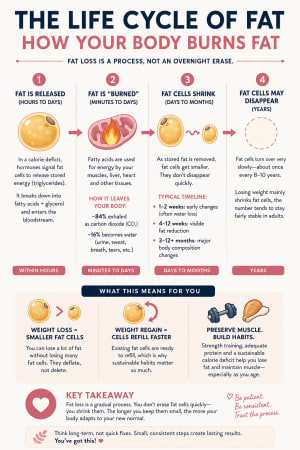
Here’s the life cycle:
1. Fat is released from the fat cell (hours to days)
When you are in a calorie deficit (through nutrition, activity, or both), hormones signal fat cells to release stored energy.
Stored fat (triglycerides) is broken into:
Fatty acids
Glycerol
These leave the fat cell and travel through the bloodstream to be used for energy.
This can happen within hours of a calorie deficit or exercise session.
2. Fat is “burned” (minutes to days)
Your body uses those fatty acids in:
Muscles
Liver
Heart
Other tissues
Most people imagine fat turning into energy or “sweat,” but chemically:
Most fat leaves your body through breathing.
Roughly:
~84% is exhaled as carbon dioxide (CO₂)
~16% becomes water (urine, sweat, breath, tears, etc.)
For example, losing 10 pounds of fat means much of it literally left your body through your lungs over time.
3. Fat cells shrink (days to months)
As stored fat is removed, the fat cells get smaller.
They do not disappear quickly.
Think of fat cells like balloons:
Weight gain = balloons fill up
Weight loss = balloons deflate
You can lose a lot of body fat while still having roughly the same number of fat cells.
How quickly do fat cells shrink?
Depends on deficit size and the person, but noticeable shrinking usually occurs over:
1–2 weeks: early reduction (often mixed with water loss)
4–12 weeks: visible fat reduction
3–12+ months: major body composition changes
A realistic fat loss pace for preserving muscle is usually:
~0.5–1% of body weight per week
This is especially important after 40 and for people using GLP-1s, where losing too fast increases risk of muscle loss.
4. Do fat cells ever disappear?
Yes — but slowly.
Research suggests fat cells have a turnover rate of roughly ~8–10 years in adults. Your body is constantly replacing some fat cells, but the total number tends to stay fairly stable once adulthood is reached.
Important nuance:
If you lose weight:
Fat cells mostly shrink
You still have many of the same fat cells
They are “emptier” and metabolically quieter
If you regain weight:
Those existing cells often refill faster than creating brand-new fat cells.
Can fat cell number decrease?
Possibly with large, sustained weight loss, but the body tends to defend fat cell number.
When do fat cells increase?
Usually:
During childhood/adolescence
Significant adult weight gain/obesity
Once new fat cells are created, they tend to stick around long term.
Why this matters for maintenance
This helps explain why weight regain can happen:
After weight loss:
Fat cells are still there
Hunger hormones often rise
Energy expenditure may decrease somewhat
The body often “wants” to refill those cells
That’s why strength training + adequate protein + sustainable habits matter so much — especially for your RBC audience wanting to age well and keep muscle.
A useful way to explain it to clients:
“You don’t really delete fat cells quickly — you shrink them. The longer you keep them small, the more your body adapts to the new normal.”
One caveat: the exact timeline for fat cell turnover in humans is still being studied, and individuals vary. The strongest evidence supports shrinking as the primary mechanism of fat loss, not rapid fat cell disappearance.